How to remove slime stains from fabric, carpet and more
To remove slime stains, lift off as much as you can, then soak what's left with white vinegar so the gel turns runny, blot it out and rinse with dish soap and warm water. Vinegar works because it breaks the borate links that hold slime together, leaving ordinary water-soluble glue. Treat any color left behind as a dye stain with oxygen bleach.
- Best method
- Lift off, white vinegar, then dish soap
- Time
- 15 to 30 minutes; longer for dried slime
- Difficulty
- Easy
- Stain type
- Glue, paint and polymers
You will need
- Dull knife or spoon
- White vinegar
- Liquid dish soap or laundry detergent
- White cloths or paper towels
- Oxygen bleach, for leftover color
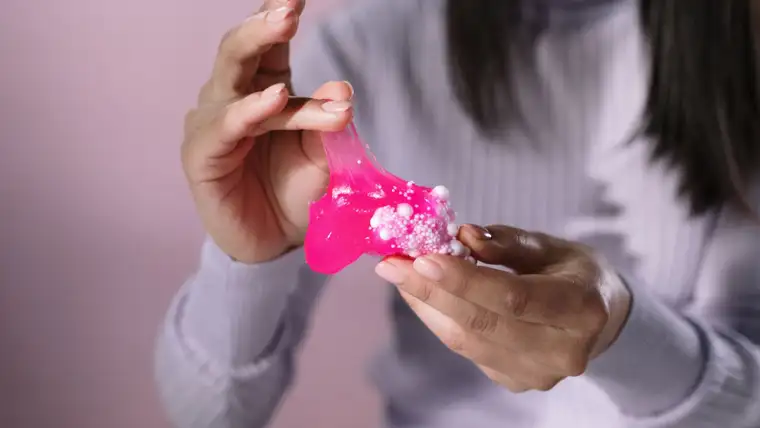
How to remove slime stains
- 1
Lift off the bulk first
Pick and scrape off as much slime as you can with a dull knife or spoon before adding any liquid. Pressing a bigger ball of the same slime onto the spot can pull off small pieces, because slime sticks to itself better than to fibers.
Why: Every bit you lift dry is a bit you don't have to dissolve and blot out of the fibers.
- 2
Soak the residue with white vinegar
Dab undiluted white vinegar onto the remaining slime, or on carpet and upholstery use the Carpet and Rug Institute's solution of 1 cup white vinegar to 2 cups water. Let it sit a few minutes until the gel loosens, then blot.
Why: Slime is glue held together by borate cross-links. Acid breaks those links, so the gel turns back into a thin liquid that can be blotted up.
- 3
Work in dish soap and rinse warm
Work a little liquid dish soap or liquid laundry detergent into the spot with your fingers or a soft brush, then rinse with warm water. On carpet or a couch, blot the soap solution on, then blot with plain water.
Why: Once the cross-links are gone, the leftover glue polymer is water-soluble, and detergent carries it away.
- 4
Wash washable items warm
Launder clothes and sheets in the warmest water the care label allows.
Why: The polymer is water-based, so a warm wash removes the last of the film.
- 5
Bleach out any dye
If a colored mark remains, soak the item in an oxygen bleach solution. On colorfast white cotton whose label allows it, chlorine bleach is an option, but only after rinsing the vinegar out completely.
Why: Colored slime contains dye that can bind to fibers like any other dye stain.
- 6
Air-dry and check
Let the item air-dry and look at it in daylight. Repeat the vinegar and soap steps if you can still feel stiffness or see color.
Why: Dryer heat turns leftover polymer into a hard film and sets any dye.
What slime is, and why vinegar undoes it
Most toy slime is a glue: either white or clear school glue (polyvinyl acetate) or polyvinyl alcohol. Borax or another borate activator links the long polymer chains together with weak, reversible bonds, which turns the liquid into a stretchy gel. That gel wraps around fibers, and many slimes also carry dye or glitter.
Because the bonds are reversible, you can take them apart. An acid such as white vinegar breaks the borate links, and the gel slumps back into runny glue. That's why scrubbing slime with plain water mostly smears it, while vinegar followed by detergent lifts it out. Slime belongs with the adhesive stains, and the Royal Society of Chemistry warns that its dyes can leave permanent marks on clothes.
How the method changes by surface
The chemistry is the same everywhere; what changes is how much liquid the surface can take. Washable clothes and sheets can be soaked and laundered. Carpet and couches get the vinegar solution on a cloth, blotted from the edges inward, with as little liquid as possible so nothing soaks into padding or cushion foam. For upholstery, check the cleaning code and test on a hidden spot first.
Slime in hair is a different problem because you're working on skin, so the hair guide uses gentler steps.
Slime on every surface
The method changes with the surface: fabrics can soak, carpets and mattresses can't. Pick yours for the full steps.
By situation
Dried slime
Dried slime behaves like dried glue. Soak it with vinegar or warm water for several minutes to soften it before scraping, then use detergent. Dried dyed slime is more likely to leave color behind, so plan on an oxygen bleach soak.
It went through the wash
The wash may have spread the slime into a thin glue film. Treat the stiff area again with vinegar, work in detergent and rewash.
It went through the dryer
Scrape off any hardened film, soak the item in warm water with detergent, then use oxygen bleach for remaining color. Heat-set slime doesn't always come out completely.
White versus colored fabric
On whites, chlorine bleach (if the label allows) or oxygen bleach removes leftover dye. On colors, use only oxygen bleach and test it first. Vinegar can shift some dyes too, so test it on a seam; the Kentucky extension guide notes that rinsing and a few drops of ammonia can often reverse an acid color change.
Silk, wool, velvet and dry-clean-only items
Lift off what you can without wetting the fabric and take the item to a dry cleaner. Vinegar is an acid, and Michigan State's extension bulletin warns that acids can damage wool and silk.
What not to do
- Don't rub wet slime into fabric or carpet. Rubbing spreads the gel and its dye deeper into the fibers.
- Don't put the item in the dryer until the slime is gone. Heat dries the polymer into a film and sets any dye.
- Don't use chlorine bleach on a spot that still has vinegar in it. Bleach and acid together release chlorine gas. Rinse thoroughly between products, and see never mix these cleaners.
- Don't flood carpet or upholstery. Liquid soaks into the padding or cushion, where it's hard to extract and can leave a ring or mildew.
Other methods that work
Ice
Rubbing an ice cube over soft slime firms it so it peels off in bigger pieces, the same idea used for gum. It's traditional, with weak evidence, and only helps with the bulk.
Caution: You still need vinegar and detergent for the residue.
Rubbing alcohol
Often suggested for clear-glue slime residue. No extension or manufacturer guide recommends it for slime specifically, so treat it as traditional, weak evidence.
Caution: It can fade some dyes and is flammable. Test it on a hidden spot first.
Dish soap alone
A dilute dish soap solution is the Carpet and Rug Institute's second step for white glue and helps rinse out the polymer once it has softened. It works better after vinegar than instead of it.
Caution: On carpet, rinse until no soap remains, because residue attracts dirt.
Stain still there?
The spot still feels stiff after washing
That's glue film left after the borate links were broken. Rewet it with vinegar for a few minutes, work in detergent and rinse in warm water.
The slime is gone but a colored mark remains
Treat it as a dye stain: soak in oxygen bleach solution for colors, or use chlorine bleach on colorfast whites if the label allows, after rinsing out the vinegar.
A large dyed spill still transfers color on light carpet or upholstery
Stop and call a professional carpet or upholstery cleaner. More liquid will mostly spread the dye.
Safety
- Never use vinegar and chlorine bleach on the same spot without rinsing thoroughly in between.
- Keep borax and slime activators away from small children.
Never mix cleaning products; see chemicals you must never combine.
Questions
What dissolves slime?
White vinegar. Its acid breaks the borate bonds that turn glue into slime, so the gel goes runny and can be blotted out. Dish soap and warm water then rinse away the glue.
How do you get dried slime out of carpet?
Soften it with a solution of 1 cup white vinegar to 2 cups water on a white cloth, blot from the edges in, then blot on a dilute dish soap solution, rinse with warm water and blot dry.
Do slime stains come out of clothes?
Usually, if you dissolve the gel with vinegar before washing and keep the item out of the dryer. Dyed slime can leave color that needs an oxygen bleach soak, and some heat-set marks are permanent.
Can you put slime-stained clothes in the washing machine?
Only after you've lifted off the bulk and treated the spot with vinegar and detergent. Washing untreated slime tends to spread it into a stiff film.
Other glue, paint and polymers
Sources
- PVA polymer slime (class experiment), Royal Society of Chemistry
- Spot Solver: Glue, White, The Carpet and Rug Institute
- Quick and Easy Stain Removal for Clothing (HS 305, May 2026), Iowa State University Extension and Outreach
- Stain Removal for Washable Fabrics (HE 2-840), University of Kentucky Cooperative Extension Service
- A General Guide to Stain Removal (Extension Bulletin E-1453), Michigan State University Cooperative Extension Service (archived bulletin)
- Chlorine gas: What happens if you mix bleach and other cleaners, National Capital Poison Center (Poison Control)
Last updated . Methods are drawn from the sources above; how we research and check our guides.