How to remove glue stains: super glue, school glue and hot glue
To remove glue stains, first identify the glue. Water-based white, school and most wood glues soak out in cold water and detergent. Super glue has to cure, then softens with acetone on fabrics that can take it. Hot glue and other adhesives harden with ice, scrape off, and the residue dissolves in a prewash stain remover. Each glue sets differently, so the solvent has to match the glue.
- Best method
- Match the solvent to the glue: water, acetone or prewash remover
- Time
- 15 minutes to overnight, depending on the glue
- Difficulty
- Moderate
- Stain type
- Glue, paint and polymers
You will need
- Dull knife
- Ice or a freezer
- Cold water and liquid detergent
- Acetone nail polish remover, for super glue
- Prewash stain remover or cleaning fluid, for other adhesives
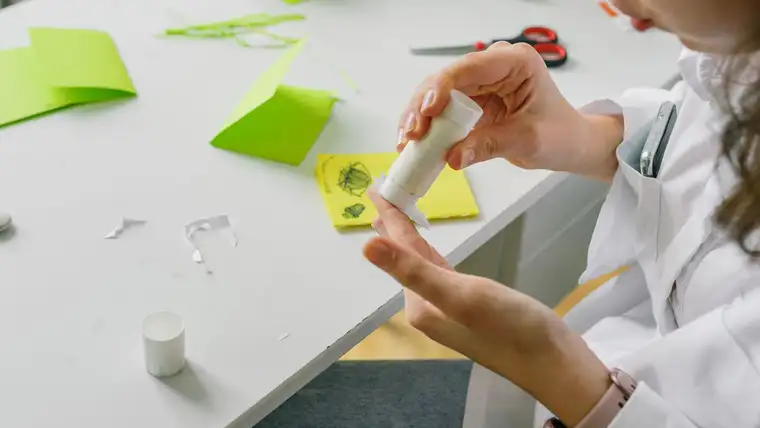
How to remove glue stains
- 1
Identify the glue
White, school and most wood glues are water-based. Super glue is cyanoacrylate. Hot glue is a plastic that melts and resets. Glue sticks are water-soluble and sometimes colored.
Why: Each type sets differently, so the type decides whether water, acetone or a solvent will work.
- 2
Harden and scrape off the bulk
Chill hot glue or soft adhesives with ice, or put a small item in the freezer overnight, then scrape off what you can with a dull knife. Let super glue cure fully before scraping.
Why: Cold makes adhesives brittle so they lift instead of stretching.
- 3
Water-based glue: cold soak and detergent
Soak white, school or wood glue in cold water, then work in liquid detergent and launder. For glue sticks, rinse with hot water until no color comes out.
Why: These glues are polyvinyl acetate in water, and they soften or redissolve in water, especially before they've fully dried.
- 4
Super glue: acetone on compatible fabric
After a cold-water soak, test acetone on a hidden seam, then dab it on with a cotton swab from the edge inward and blot the softened glue. Repeat, then rub in heavy-duty detergent and launder.
Why: Acetone softens cured cyanoacrylate. It also dissolves acetate and triacetate, hence the test.
- 5
Other adhesives: prewash remover
Saturate sticker residue, tape adhesive and similar residues with a prewash stain remover or cleaning fluid, then rinse and launder.
Why: Solvent-based pretreatments dissolve many adhesive residues that water can't.
- 6
Air-dry and check
Air-dry and feel for stiffness before using the dryer.
Why: Heat hardens and fixes any glue film that's left.
Why each glue needs its own method
Glue is a broad family of adhesive stains. White, school and many wood glues are polyvinyl acetate dispersed in water: water-soluble until they dry into a film, and even then a long soak softens them. Super glue is cyanoacrylate, which cures in seconds when it touches moisture and turns into a hard plastic; acetone softens it. Hot glue is a thermoplastic that's soft when hot and rigid when cool, so freezing helps. Glue sticks are water-soluble, and colored ones can leave dye.
That's why there's no single glue remover. Using acetone on school glue wastes effort, and using water on cured super glue does almost nothing.
Glue on every surface
The method changes with the surface: fabrics can soak, carpets and mattresses can't. Pick yours for the full steps.
By situation
Dried white or school glue
Wet glue rinses out easily. Dried glue needs a long cold soak and may leave a stiff, shiny patch; soak again, work in detergent and rewash.
Glue that went through the wash and dryer
It may have hardened further. Scrape, then use the right solvent for the type, a water soak or acetone, and rewash.
Colored or glitter glue
Remove the glue first, then soak in oxygen bleach for leftover dye. One glue-stick maker suggests an hour's soak in oxygen bleach solution, then air-drying and rewashing.
Acetate, silk, wool and dry-clean-only items
Acetone dissolves acetate and triacetate and damages modacrylic, and an adhesive maker warns it can harm fine silk and wool. Take these to a dry cleaner.
Glue in hair or on carpet
Hair and skin need gentle oils and soap rather than strong solvents; see glue in hair. On carpet, the Carpet and Rug Institute starts white glue with a vinegar solution and school glue with a dilute detergent solution; see glue on carpet.
What not to do
- Don't use acetone on acetate, triacetate or modacrylic. It dissolves or damages these fibers.
- Don't dry an item with glue residue. Heat sets the residue.
- Don't let a large amount of liquid super glue soak into cotton or wool you're wearing. Cyanoacrylate reacts quickly with cotton and wool and gives off heat that can burn skin.
Other methods that work
Warm white vinegar
An adhesive maker suggests warm white vinegar for sticker residue on fabric, and a vinegar solution is the Carpet and Rug Institute's first step for white glue on carpet.
Caution: Test colors, and never use it with bleach.
Rubbing alcohol
The same adhesive maker lists rubbing alcohol for sticker residue on fabric.
Caution: It can fade some dyes and is flammable.
Stain still there?
A stiff, shiny patch is left
That's a dried glue film. For water-based glue, soak again in cold water and work in detergent. For super glue, repeat the acetone on compatible fabric.
Acetone isn't softening the glue
It may not be super glue. Try a long water soak for water-based glue, or a prewash stain remover for other adhesives.
Safety
- Acetone and cleaning solvents are flammable. Ventilate and keep them away from flames.
- If super glue bonds skin, don't pull it apart; soak in warm soapy water and peel gently. Get medical help for glue in or near the eyes.
Never mix cleaning products; see chemicals you must never combine.
Questions
How do you get super glue out of clothes?
Let it dry, scrape off the excess, soak in cold water, then dab acetone on with a cotton swab and blot. Repeat, rub in heavy-duty detergent and launder. Skip acetone on acetate and triacetate.
How do you remove school glue from clothes?
Soak in cold water, work in liquid detergent and launder. Dried glue just needs a longer soak.
How do you remove wood glue from clothes?
Most wood glues are water-based, so rinse and soak them while wet. Dried wood glue softens with a long soak before washing.
How do you get hot glue off fabric?
Freeze the item, ideally overnight, then crack and scrape the brittle glue off. Treat any residue with a prewash stain remover and launder.
Other glue, paint and polymers
Sources
- Stain Removal Guide, American Cleaning Institute
- Stain Removal for Washable Fabrics (HE 2-840), University of Kentucky Cooperative Extension Service
- How to remove glue from fabric: a simple guide, Henkel (adhesive manufacturer guidance)
- Glue Sticks on Clothing or Fabrics, Crayola (manufacturer stain-removal guidance)
- Spot Solver: Glue, White, The Carpet and Rug Institute
- Is super glue toxic?, Poison Control (National Capital Poison Center)
Last updated . Methods are drawn from the sources above; how we research and check our guides.