How to clean burnt pots and pans (and stuck-on cake)
To clean a burnt pot or pan, soak it in hot water with dish detergent or baking soda for 15 to 30 minutes, then scour gently with baking soda on a plastic mesh pad. If it's still stuck, boil 3 tablespoons of baking soda per quart of water in the pan, take it off the heat, add a tablespoon of dish soap, let it cool and scrub again. Heat and alkali soften carbonized food so it lifts off without the harsh scouring that scratches cookware.
- Best method
- Hot soak, then a baking soda boil if needed
- Time
- 30 minutes to a few hours
- Difficulty
- Easy
You will need
- Hand dishwashing liquid
- Baking soda
- Plastic mesh scouring pad or nonabrasive sponge
- Wooden or plastic scraper
- Washing soda, for badly burnt stainless (optional)
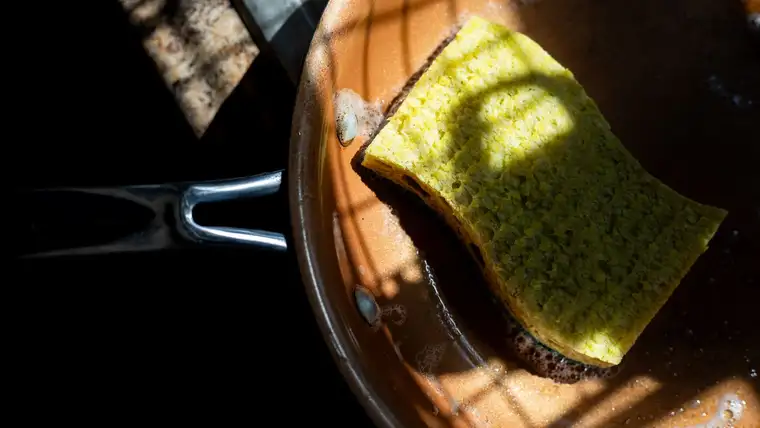
Step by step
- 1
Scrape out loose food
Scrape out what comes away easily with a wooden or plastic spatula. Pour cooled grease into a disposable can rather than down the sink.
Why: The less burnt food left, the faster the soak works. Grease clogs drains.
- 2
Soak in hot water
Fill the pan with hot water and a squirt of dish detergent, or a few tablespoons of baking soda, and leave it 15 to 30 minutes. Wash your plates and glasses first and the pan last. Check the maker's instructions first if the pan shouldn't be submerged.
Why: Hot water and detergent soften and swell stuck-on soil so it loosens from the metal.
- 3
Scour gently
Scrub with a plastic mesh pad or sponge sprinkled with baking soda or a mild abrasive cleaner.
Why: Baking soda is a mild abrasive and a weak alkali: it lifts residue without the deep scratches that make pans soil faster next time.
- 4
Boil baking soda for stubborn burns
If it's still stuck, add 3 tablespoons of baking soda per quart of water to the pan, bring it to a boil, take it off the heat, stir in 1 tablespoon of hand dishwashing liquid and let it cool. Then scrub again with baking soda on a plastic pad.
Why: The hot alkaline solution loosens carbonized residue that a cold soak can't. This is the American Cleaning Institute's method.
- 5
Rinse and dry
Rinse well and dry the pan, especially stainless steel, which spots if water air-dries on it.
Why: Leftover detergent or baking soda can leave a film, and drying prevents water spots.
Match the method to the pan
Stainless steel is the most forgiving. After the soak or baking soda boil, a baking soda paste on a nonabrasive pad handles most burns. For badly burnt-on food, the European stainless steel association suggests dissolving a few teaspoons of washing soda in hot water in the pot and leaving it for some hours, which loosens deposits or makes them flake off. Stainless steel wool pads can be used on stainless pots if needed; they may leave superficial scratches but won't harm corrosion resistance. Never use ordinary steel wool on stainless: it scratches and leaves iron that rusts.
Aluminum is darkened and corroded by strong alkalis, so skip washing soda and chlorine bleach, and go easy with baking soda, which can also darken it. Detergent soaks and gentle scrubbing are safest.
Non-stick pans scratch, so no steel wool or harsh abrasives at all: soak, then a soft sponge. Bare cast iron follows its own rules (no soaking): see how to clean cast iron. Enameled cast iron: soak and use a nonabrasive pad, following the maker's care guide.
Why burnt food sticks, and why gentle beats harsh
When food overheats, sugars, proteins and fats break down and carbonize into a hard, black layer that bonds to the metal. Water alone barely touches it, but heat plus an alkali such as baking soda softens and loosens it over time. That's why soaking and boiling do most of the work.
Scouring hard with coarse abrasives works in the moment, but New Mexico State Extension notes that regular harsh scouring dulls and roughens cookware, so food sticks and soils it faster next time. Save coarse abrasives for very tough surfaces and use mild ones by default. How often: wash cookware the same day and soak anything stuck right away, before it dries on.
By situation
Burnt stainless steel pan
Soak, then do the baking soda boil and scrub with a baking soda paste. For a really bad burn, a hot washing soda soak for some hours loosens the carbon. Dry it afterward to avoid spots.
Burnt pans from the oven (sheet pans and baking dishes)
Soak with hot water and detergent or baking soda for 15 to 30 minutes, then scour with baking soda on a plastic pad. Many sheet pans are aluminum, so avoid washing soda and bleach. Check the maker's instructions for insulated or air-cushioned bakeware, which shouldn't be submerged.
Baked-on cake or batter in a pan
Cake residue is sugar, egg and fat, which soak loose easily. Fill the pan with hot soapy water, leave it 15 to 30 minutes, then wipe or scrub gently with a plastic pad. For a non-stick or fluted cake pan, use a soft brush in the crevices rather than anything abrasive.
A whole cake stuck in the pan
One baking company's guidance for fluted cake pans: loosen the edges with a thin spatula or table knife as soon as the cake comes out of the oven, turn the pan upside down onto a cooling rack, and lift the pan off after 10 minutes. Next time, grease the pan thoroughly, including non-stick pans; pan spray works well.
Burnt sugar or caramel
Sugar dissolves in hot water. Fill the pan with water and bring it to a simmer to melt the hardened sugar, then wash as usual. Follow with the baking soda boil if dark carbon remains.
What not to do
- Don't use ordinary steel wool on stainless steel or non-stick pans. It scratches the surface, and on stainless it leaves iron particles that cause rust spots.
- Don't use washing soda or chlorine bleach on aluminum. Washing soda corrodes aluminum, and strong alkalis and bleach darken it.
- Don't use automatic dishwasher detergent for hand washing unless the label says so. The American Cleaning Institute warns against using it for hand washing.
- Don't pour grease down the sink. It causes clogs. Let it cool and put it in a disposable can.
Other methods that work
Washing soda soak (stainless only)
A few teaspoons of washing soda dissolved in hot water in the pot, left for some hours, loosens badly burnt-on food.
Caution: Not for aluminum. Washing soda is a stronger alkali than baking soda; wear gloves.
Stainless steel scouring pad
For very stubborn deposits on stainless pots, a stainless (not ordinary) steel wool pad can be used.
Caution: It leaves superficial scratches. Never on non-stick, aluminum or decorative stainless.
Stain still there?
A brown or rainbow stain remains on stainless steel
Scrub with a baking soda paste on a nonabrasive pad, rinse and dry. For carbon that won't budge, try the washing soda soak.
An aluminum pan turned dark
Alkalis such as dishwasher detergent, washing soda or bleach darken aluminum. Avoid them in future and wash with dish detergent only.
Still burnt after one round
Repeat the baking soda boil and let it cool longer before scrubbing. Multiple gentle rounds are better than one harsh scour.
Safety
- Let the pan cool before handling, and be careful when boiling solutions in it.
- Wear gloves when using washing soda.
Never mix cleaning products; see chemicals you must never combine.
Questions
How do you clean a stainless steel pan when it's burnt?
Soak it in hot soapy water, then boil 3 tablespoons of baking soda per quart of water in it, add a tablespoon of dish soap, let it cool and scrub with baking soda on a plastic pad.
How do you get burnt-on food off a pan without scratching it?
Let heat and baking soda do the work: soak, then boil a baking soda solution in the pan, cool, and scrub with a plastic mesh pad rather than steel wool.
How do you get a cake out of a pan without breaking it?
Loosen the edges with a thin spatula or knife as soon as it comes out of the oven, turn the pan over onto a rack, and lift the pan off after about 10 minutes. Greasing the pan well prevents sticking.
Does vinegar and baking soda clean burnt pans?
Mixed together they neutralize each other, so they're weaker than either alone. A baking soda boil followed by dish soap is the method the American Cleaning Institute gives.
More guides for this room
- How to clean an air fryer, basket and heating element
- How to clean cast iron, and get rust off it
- How to clean a coffee maker with vinegar (and other descalers)
- How to clean a dishwasher and get rid of the smell
- How to clean granite countertops and remove stains
- How to remove grease from kitchen cabinets
- How to clean marble countertops, floors and showers
- How to clean a microwave and get smells out of it
- How to clean an oven, oven racks and oven glass
- How to get tomato stains out of plastic containers
- How to clean quartz countertops and get stains out
- How to clean a refrigerator and get bad smells out
Sources
- Pots and Pans, American Cleaning Institute
- Selection and Use of Home Cleaning Products, Guide G-304, New Mexico State University Cooperative Extension Service
- Cleaning Stainless Steel Appliances, American Cleaning Institute
- Frequently Asked Questions: Cleaning Stainless Steel in the Home, Euro Inox (hosted by worldstainless)
- Care of Metals and Kitchenware, Pacific Northwest Cooperative Extension (Oregon State, Washington State, University of Idaho)
- Bundt Cake (baking guide), King Arthur Baking Company
- Sodium bicarbonate, Wikipedia
Last updated . Methods are drawn from the sources above; how we research and check our guides.