How to clean a refrigerator and get bad smells out
To clean a refrigerator, empty it and throw out old food, wash the shelves and drawers in warm soapy water, wipe the walls and door gaskets with a baking soda solution, rinse, and leave the door open about 15 minutes to dry. For a bad smell, the source is spoiled food or dried spills, so clean those out first; activated charcoal or baking soda then absorbs what lingers. Fragrance just transfers to food.
- Best method
- Empty, wash with baking soda solution, dry, absorb odors
- Time
- 45-90 minutes; several days for a stubborn odor
- Difficulty
- Easy
You will need
- Cooler for perishables
- Dish soap and warm water
- Baking soda
- Soft cloths or sponges (no abrasives)
- Unscented chlorine bleach, for sanitizing (optional)
- Activated charcoal, for persistent odors
Step by step
- 1
Empty it and discard old food
For a deep clean, unplug the fridge or turn it off. Take everything out, throw away expired or questionable food, and keep perishables in a cooler while you work.
Why: Spoiled food is the source of most fridge smells, and a cooler keeps the rest safe while the fridge is warm.
- 2
Wash shelves and drawers
Remove shelves and crisper drawers and wash them by hand in warm soapy water. Let cold glass shelves come up to room temperature first.
Why: Hot water on cold glass can make it crack. Drawers and shelf rails hold the drips that cause odors.
- 3
Wipe the interior with baking soda solution
Dissolve baking soda in warm water (about 1 tablespoon per quart) and wipe the walls, ceiling, door bins and the folds of the door gasket. Rinse with a cloth dampened in clean water.
Why: Baking soda cleans and neutralizes acidic odor compounds without scratching the plastic liner.
- 4
Sanitize if food spoiled (optional)
After spoilage or raw meat drips, follow with a separate rinse of 1 tablespoon unscented liquid chlorine bleach per gallon of water, applied with a cloth. Don't use it in the same step as vinegar.
Why: The dilute bleach rinse sanitizes surfaces that held spoiled food. Mixed with vinegar or ammonia, bleach releases toxic gas.
- 5
Air-dry, then reload
Leave the doors open about 15 minutes so everything dries. Wipe bottles and jars as you put them back, and set an open box of baking soda in the back.
Why: Drying prevents mildew, and the baking soda helps keep odors down between cleanings.
- 6
Clean the coils
With the fridge unplugged, remove the kick plate at the bottom front (or pull the fridge out if the coils are at the back) and vacuum or brush off the dust with a coil brush.
Why: The American Cleaning Institute includes this step in a full fridge clean. Dust on the coils is commonly linked to reduced efficiency, though that isn't stated by the source.
What a fridge is made of, and what that rules out
Inside is a plastic liner with glass or plastic shelves, plastic drawers and rubber door gaskets. Plastic scratches easily, so abrasive cleansers and scouring pads are out, and spoiled-food odors can soak into it over time. Cold glass shelves can crack if warm water hits them. Outside is stainless or painted steel; wipe stainless with a microfiber cloth along the grain.
Sources differ on the baking soda strength. University of Illinois Extension uses 2 teaspoons per quart of water, the American Cleaning Institute 2 tablespoons per quart, and the USDA-based guidance about 1 tablespoon per quart. The exact amount isn't critical; any of these is mild and safe on the liner.
How often: wipe spills when they happen, apply cleanser to a cloth rather than spraying it into a full fridge, purge expired food weekly, and do a full empty-and-wash at least once a year.
How to get a bad smell out of a fridge
Fridge odor comes from food that's spoiling and from spills dried onto shelves, drawers, gaskets and the drip area. Bacteria and molds break food down into volatile amines, sulfur compounds and acids. Cold slows this but doesn't stop it, and in a closed box the smell builds and passes into other food and the plastic. That's why an air freshener fails: it doesn't remove the residue and its scent can end up in your food.
- Remove the source and wash everything as above. A wipe with 1 cup of vinegar per gallon of water is an alternative to baking soda, used on its own, never with bleach.
- Absorb what's left. Activated charcoal (from drug or pet supply stores, not barbecue charcoal) is the most effective option in the extension guidance: trays of it in the empty fridge for several days. Baking soda, clean kitty litter or freshly ground coffee on trays with the fridge running empty for 2 to 3 days also work.
- For a strong smell, pack the shelves with crumpled newspaper, sprinkle it with water and run the fridge empty for 5 to 6 days.
For a specific smell, see spoiled milk odors or fish smells.
By situation
After a power outage or spoiled food
Discard the spoiled food, then wash shelves, drawers and ice trays in hot soapy water and the interior with baking soda solution, rinse, sanitize with the dilute bleach rinse, and air out. If the smell remains, use activated charcoal for several days. If drippings soaked into the insulation, the odor may be impossible to remove; contact the maker.
Freezer smells
Use the same method: empty, wash with baking soda solution, dry, and set out activated charcoal or baking soda.
Fish smell in the fridge
Wipe with dilute vinegar: acids make the amines that cause fish smell less volatile. Wrap fish well in future and wipe drips right away.
Stainless steel fridge exterior
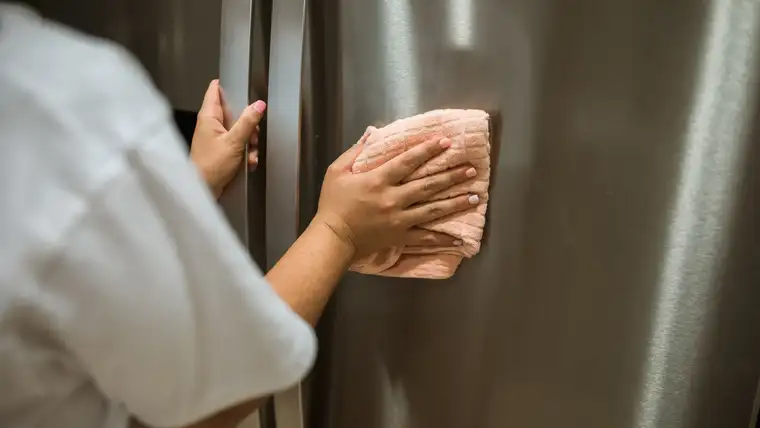
Wipe with a microfiber cloth and a stainless steel cleaner or mild soapy water, always along the grain,. See stainless steel appliances.
The smell won't go away
Iowa State Extension lists a few more options from USDA: a vanilla-soaked cotton ball inside for 24 hours, or leaving the door open for several days. If odor still can't be removed, the fridge may have to be replaced. Take the door off before discarding it so a child can't get trapped inside.
What not to do
- Don't use abrasive cleansers or scouring pads inside. The plastic liner scratches easily.
- Don't pour warm water on cold glass shelves. The sudden temperature change can crack the glass.
- Don't spray cleanser into a fridge full of food. Apply it to the cloth instead so it doesn't get on food.
- Don't combine bleach with vinegar or ammonia. The mixture releases toxic gas. Use the bleach rinse as a separate step. See what never to mix.
- Don't mask the smell with fragrance. It doesn't remove spoiled residue, and the scent can transfer to food.
Other methods that work
Vinegar solution
One cup of white vinegar per gallon of water, or equal parts vinegar and water for persistent odors, washes and deodorizes the interior.
Caution: Use it on its own and rinse before any bleach step.
Coffee grounds or newspaper
Freshly ground coffee on cookie sheets for 2-3 days, or crumpled damp newspaper for 5-6 days, absorbs strong odors in an empty, running fridge.
Caution: Coffee can leave a slight coffee smell for a while.
Stain still there?
It still smells after cleaning
Check the places people miss: the drawer rails, under the crisper drawers, the gasket folds and the water or ice dispenser (clean that per the manual). Then use activated charcoal for several days.
The ice tastes or smells bad
Discard old ice, wash the ice trays or bin in hot soapy water, and clean the dispenser as the manual directs. Then clean the freezer the same way as the fridge.
Safety
- Unplug the fridge before cleaning the coils or the area under it.
- Remove the door from any fridge you're discarding so children can't be trapped.
Never mix cleaning products; see chemicals you must never combine.
Questions
What is the best way to get a bad smell out of a fridge?
Throw out the source, wash the interior with baking soda solution, dry it, then leave activated charcoal or baking soda inside for a few days. Activated charcoal works fastest.
Does an open box of baking soda really help?
It helps keep everyday odors down. The American Cleaning Institute suggests keeping one in the fridge year-round, but it won't fix a smell from spoiled food you haven't removed.
How do you clean fridge coils?
Unplug the fridge, remove the kick plate or pull it out to reach the coils, and vacuum or brush off the dust with a coil brush.
Can I clean my fridge with vinegar?
Yes. A solution of about 1 cup vinegar per gallon of water is safe on the liner and helps with odors. Just never use it together with bleach.
More guides for this room
- How to clean an air fryer, basket and heating element
- How to clean burnt pots and pans (and stuck-on cake)
- How to clean cast iron, and get rust off it
- How to clean a coffee maker with vinegar (and other descalers)
- How to clean a dishwasher and get rid of the smell
- How to clean granite countertops and remove stains
- How to remove grease from kitchen cabinets
- How to clean marble countertops, floors and showers
- How to clean a microwave and get smells out of it
- How to clean an oven, oven racks and oven glass
- How to get tomato stains out of plastic containers
- How to clean quartz countertops and get stains out
Sources
- Cleaning the Refrigerator, American Cleaning Institute
- Clean and Sanitize the Kitchen, University of Illinois Extension
- Removing Refrigerator Odors, Iowa State University Extension and Outreach - AnswerLine
- Our Best Refrigerator Cleaning Tips / How to Deep Clean and Sanitize Your Refrigerator, GE Appliances (manufacturer)
- Removing Odors from Refrigerators and Freezers after Food has Spoiled (ER-005; adapted from Clemson HGIC 'Food Safety in Hurricanes and Floods'), Texas A&M AgriLife Extension
- Solving Odor Problems in Your Refrigerator or Freezer (source: USDA), University of Nebraska-Lincoln Extension (Food)
- Is Fish Smelly?, American Society for Nutrition (citing McGee, On Food and Cooking)
- Chlorine gas: What happens if you mix bleach and other cleaners, Poison Control (National Capital Poison Center)
Last updated . Methods are drawn from the sources above; how we research and check our guides.