Cleaning with baking soda: what it cleans and what it doesn't
Baking soda (sodium bicarbonate) cleans in three ways: as a gentle abrasive in a paste, as a mild alkali that loosens greasy and acidic soil, and as an odor absorber. It's the mildest household alkali, safe on most surfaces, but it isn't a soap, a bleach or a disinfectant. It darkens aluminum, and mixing it with vinegar only neutralizes both.
- Best method
- Scrubbing paste, fridge wipe-down and dry deodorizing
- Time
- About 15 minutes on carpet before vacuuming; a few minutes of scrubbing
- Difficulty
- Easy
You will need
- Baking soda
- Warm water
- A damp cloth, sponge or soft brush
- A vacuum, for carpet deodorizing
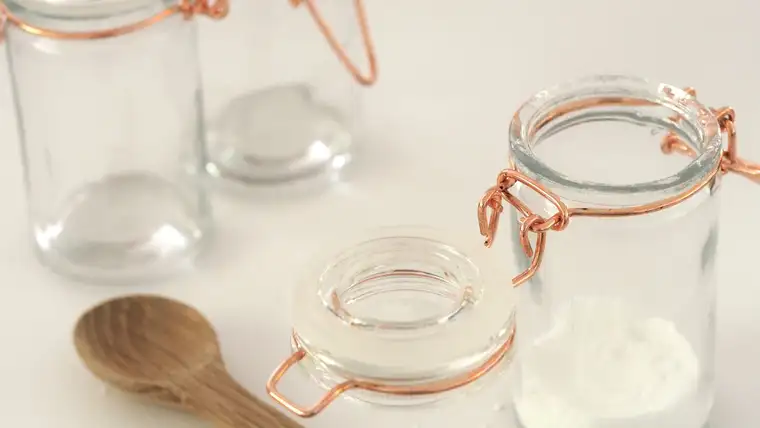
Step by step
- 1
Pick the form for the job
Use it dry to absorb odors, as a paste to scrub, or dissolved in water to wipe surfaces that shouldn't smell of soap, such as the inside of a refrigerator.
Why: Each form uses a different property: absorbing, abrading or dissolving soil with mild alkalinity.
- 2
For a wipe-down, dissolve 2 tablespoons per quart
Stir 2 tablespoons of baking soda into 1 quart of warm water for a refrigerator or similar surface. For a paste, add water a little at a time to the powder until it holds together.
Why: Warm water dissolves the powder fully, so there are no gritty bits left on the shelves.
- 3
Test polished surfaces first
On glossy finishes, polished stone, quartz or soft plastics, rub a little paste on a hidden spot and check it in good light before scrubbing a large area. Don't use it on aluminum.
Why: It's a mild abrasive, but repeated scrubbing can still dull a polished surface, and alkalis darken aluminum.
- 4
Scrub gently
Work the paste over sinks, tubs, tile, stainless steel or the oven interior with a damp cloth or soft brush. Use light pressure and let the powder do the work.
Why: The fine crystals lift stuck-on soil, and the mild alkali helps loosen grease.
- 5
Rinse and wipe dry
Rinse with clean water and wipe the surface dry, so no powdery film is left behind.
Why: Baking soda isn't a surfactant, so it doesn't carry soil away on its own. Rinsing removes both the soil and the powder.
- 6
To deodorize carpet, sprinkle, wait and vacuum
Sprinkle baking soda over dry carpet, leave it about 15 minutes, then vacuum thoroughly.
Why: The powder absorbs and neutralizes acidic odor compounds in the pile, then leaves with the vacuum.
What baking soda is and how it cleans
Baking soda is sodium bicarbonate, sold as a pure food-grade powder in US grocery stores. Dissolved in water it is only slightly alkaline. University of Georgia Extension ranks it the mildest of the household alkalis: milder than ammonia and borax, and far milder than washing soda or lye.
It cleans in three ways. As a paste or dry powder, it's a gentle abrasive. As a mild alkali, it helps loosen greasy and acidic soil. And it absorbs and neutralizes odors, many of which are acidic. What it doesn't do matters too: it is not a surfactant like soap, it doesn't bleach, and it isn't a disinfectant.
What baking soda is good for, with the ratios
- Sinks, tubs, tile, stainless steel and oven interiors: a paste is a mild abrasive that is safe on most home surfaces.
- Refrigerator interiors: 2 tablespoons per quart of warm water cleans without leaving a soap smell. See how to clean a refrigerator.
- Carpet, trash cans, diaper pails and closets: sprinkle, wait about 15 minutes and vacuum carpet; for a closet, leave an open container in place.
- Pet-urine laundry: Humane World for Animals suggests adding a 1-pound box to the regular detergent for machine-washable items, then an enzyme cleaner if the odor remains.
- Crayon on a whole load: the American Cleaning Institute says to wash in hot water with laundry soap and 1 cup of baking soda. See crayon on clothes.
What baking soda damages, and the vinegar question
- Aluminum: University of Georgia Extension says baking soda darkens aluminum's finish, because alkalis attack the metal.
- Polished and delicate surfaces: even a soft cleanser can dull a surface with repeated use. Test it on high-gloss finishes, polished stone and quartz.
- Wool and silk: both are sensitive to alkalis, so keep pastes off them.
Baking soda and vinegar are not dangerous together, but they cancel out. The fizz is carbon dioxide from the acid reacting with the base, and what's left is mostly water and a salt (sodium acetate). Neither cleaning ingredient survives. Use them separately, and never seal the mixture in a closed container, where the gas builds pressure.
By situation
Carpet that smells
Make sure the carpet is dry, then sprinkle, wait about 15 minutes and vacuum. If the smell is from urine or vomit, baking soda only deals with what's on the surface. The residue in the pad needs an enzyme cleaner.
Laundry that smells of pet urine
Add a box of baking soda to the regular detergent and wash as usual. If the smell is still there after drying, treat the item with an enzyme cleaner and wash again.
A load of clothes with melted crayon
Wash the load in hot water with laundry soap and 1 cup of baking soda, if the fabrics can take hot water. Check every piece before it goes in the dryer.
Aluminum pans and fixtures
Skip baking soda. It darkens the finish. Use dish soap and water instead.
Wool and silk
Don't use a wet paste. Wool and silk are sensitive to alkalis. A brief dry sprinkle on wool carpet, vacuumed thoroughly, is lower risk than a paste.
What not to do
- Don't use baking soda on aluminum. It darkens the finish of aluminum.
- Don't expect it to disinfect. It is not an EPA-registered disinfectant, and the EPA doesn't review household ingredients for killing germs.
- Don't mix it with vinegar and seal it in a container. The reaction releases carbon dioxide, which builds pressure, and the two ingredients neutralize each other anyway.
- Don't scrub polished surfaces hard or often. Even a mild abrasive can dull a high-gloss finish over time.
Other methods that work
Washing soda
For heavy grease and laundry boosting, washing soda (sodium carbonate) is a much stronger alkali.
Caution: It is far harsher than baking soda, so wear gloves and read its own cautions first.
Enzyme cleaner
For urine, vomit and other organic odors deep in carpet or a mattress, enzymes break down the source, which baking soda can't reach.
Caution: Check the label before using it on wool or silk.
White vinegar, used separately
For mineral scale and hard-water film, an acid such as white vinegar does what an alkali can't.
Caution: Use it on its own, rinsed off, not mixed with baking soda.
Stain still there?
A white, powdery film is left behind
The baking soda wasn't fully rinsed. Wipe again with clean water and dry the surface with a cloth.
The carpet still smells after vacuuming
The source is probably below the surface, in the backing or pad. Find it, clean it with an enzyme cleaner, and let it dry completely.
The aluminum turned dark
That's the alkali reacting with the metal. Stop using baking soda on it and switch to dish soap and water.
Safety
- The fine powder can irritate eyes. Rinse with water if it gets in them.
Never mix cleaning products; see chemicals you must never combine.
Questions
Does baking soda and vinegar clean better together?
No. The acid and the base neutralize each other, and the fizz is carbon dioxide. Some health-department drain recipes still use the pair with boiling water, but a plunger or drain snake is the chemical-free option the same guide mentions.
Does baking soda disinfect?
No. It isn't an EPA-registered disinfectant. Use it to scrub and deodorize, and a registered disinfectant when you need to kill germs.
Is baking soda the same as washing soda?
No. Washing soda is sodium carbonate, a much stronger alkali. University of Georgia Extension ranks baking soda the mildest household alkali and washing soda one of the harshest.
How long do you leave baking soda on carpet?
About 15 minutes on dry carpet, then vacuum thoroughly. It absorbs surface odors, but it can't reach urine or spills that soaked into the pad.
Will baking soda scratch stainless steel?
It's mild enough for stainless steel sinks and appliances. Use light pressure and rinse well.
Other cleaning agents
- Cleaning with acetone: what it removes and what it ruins
- Cleaning with ammonia: what it cleans and what it ruins
- Cleaning with borax: what it does and how safe it is
- Cleaning with chlorine bleach: what it cleans and what it ruins
- Cornstarch and other absorbents: how they lift grease stains
- Cleaning with dish soap: what it removes and how much to use
- Dry-cleaning solvent: what it removes and how to use it safely
- Enzyme cleaners: what they break down and how to use them
- Glycerin for stain removal: what it loosens and how to use it
- Hydrogen peroxide for stains: what it removes and what it can lighten
- How to pretreat stains: sprays, gels, sticks and detergent
- Cleaning with lemon juice and citric acid: what it removes and ruins
Sources
- Care Products, University of Georgia Cooperative Extension (Textiles)
- Keeping Your Home Healthy, Safe & Clean: Living Green (June 2017), Vermont Department of Health
- Homemade Household Cleaners, FCS3319 (rev. Feb 2025), UF/IFAS Extension
- How to Remove Pet Stains and Odors, Humane World for Animals (formerly The Humane Society of the United States)
- Stain Removal Guide, American Cleaning Institute
- Can I use common household substances to kill the novel coronavirus?, U.S. Environmental Protection Agency
Last updated . Methods are drawn from the sources above; how we research and check our guides.