Cleaning with lemon juice and citric acid: what it removes and ruins
Lemon juice for cleaning works because it's a weak acid. Its citric acid dissolves mineral deposits and some rust by binding calcium and iron, and in sunlight it acts as a mild bleach on fabric. That makes it useful for rust and mildew on colorfast washables and rust marks on sinks and tubs, but the same acid etches marble and limestone and can fade dyes.
- Best method
- Rust and mildew on colorfast fabric, with salt and sun
- Time
- Until sun-dried on fabric; up to 30 minutes as a sink paste
- Difficulty
- Easy
You will need
- Fresh lemon juice or citric acid powder
- Table salt
- Direct sunlight, for fabric
- Baking soda, for a sink or tub paste
- Water for rinsing
Step by step
- 1
Test the fabric first
Dab lemon juice on a hidden area, let it dry, and check for fading. Only treat fabric that stays colorfast.
Why: Lemon juice has a bleaching effect, and sunlight makes it stronger, so it can lighten dyes along with the stain.
- 2
Sprinkle salt on the stain
Lay the item flat with the stain facing up and cover the mark with table salt.
Why: Salt holds the juice in place on the stain and adds a little abrasion. The acid and sunlight do the actual work.
- 3
Saturate it with lemon juice
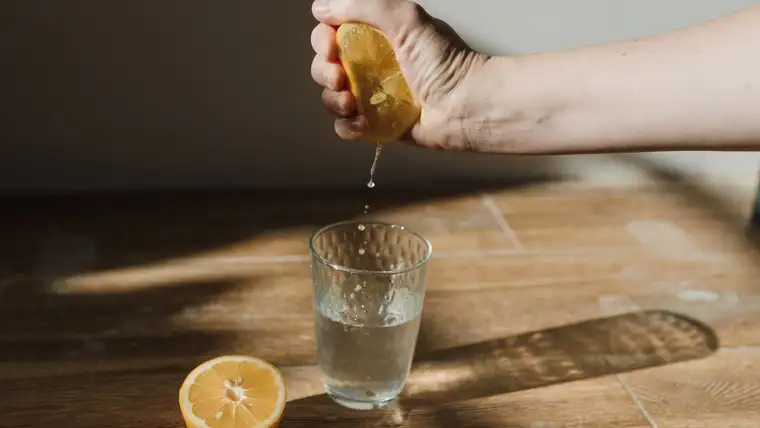
Squeeze lemon juice over the salt until the stained area is soaked through.
Why: Citric acid binds the iron in rust and dissolves it, so it can be rinsed away.
- 4
Dry it in direct sun
Leave the item in direct sunlight until it's dry.
Why: Sunlight drives the mild bleaching action that fades rust and mildew discoloration.
- 5
Rinse and repeat if needed
Rinse out the salt and juice thoroughly. If the mark has faded but not gone, repeat the treatment.
Why: Old rust and mildew stains often need more than one round.
- 6
Launder as usual
Wash the item according to its care label to remove the last of the acid and any loosened residue.
Why: Acid left in the fabric isn't needed once the stain is gone, and washing removes it.
How lemon juice and citric acid clean
Lemon juice gets most of its acidity from citric acid, a weak organic acid. Citric acid is also sold as a dry powder in canning and baking aisles and in descaling products.
The acid does three things. It dissolves mineral deposits and some rust, because citrate latches onto calcium and iron ions and holds them in solution (chemists call this chelation). Combined with sunlight, it acts as a mild bleach on fabric. And it neutralizes alkaline residues.
Its bleaching is gentle. That's why the published fabric methods pair it with salt and direct sun rather than using it alone.
What lemon juice is good for, and what it damages
Good for:
- Rust stains on colorfast washable fabric. University of Georgia guidance: sprinkle with salt, squeeze lemon juice on it, dry in the sun, rinse, and repeat.
- Mildew on fabric, as an alternative to chlorine bleach: the same salt-and-lemon method in direct sunlight, then rinse and launder.
- Rust on sinks and tubs. The Vermont Department of Health uses a paste of lemon juice with baking soda or salt, left up to 30 minutes, then rinsed.
Damages:
- Marble, limestone and travertine. The Natural Stone Institute warns that products containing lemon or other acids dull or etch calcium-based stone. See how to clean marble for what to use instead.
- Dyes. Its bleaching effect, stronger in sunlight, can lighten colored fabric. Test first.
Ratios, and what never to mix it with
- Fabric rust or mildew: sprinkle salt, saturate with lemon juice, dry in the sun, rinse. Repeat as needed.
- Sink or tub rust: lemon juice mixed with baking soda or salt into a paste, up to 30 minutes, then rinse.
The Vermont guide recommends making lemon-based cleaners fresh before each use rather than storing them.
Never mix lemon juice or citric acid with chlorine bleach. Acids react with bleach and release chlorine gas, which irritates the eyes, nose and lungs and can cause serious breathing problems. Health departments list lemon juice by name as a hidden acid in this combination. Rinse a surface thoroughly before switching products, and see never mix these cleaners.
By situation
Rust spots on white clothes
White cotton and linen are good candidates for the salt, lemon and sun method because there's no dye to fade. Repeat the treatment on stubborn marks before laundering.
Mildew on fabric that can't take chlorine bleach
Use salt and lemon juice and dry the item in direct sunlight, then rinse and launder. Test colored items first.
Rust rings in a sink or tub
Make a paste of lemon juice and baking soda or salt, leave it up to 30 minutes, and rinse well. Don't use it on a marble or limestone vanity top.
Marble, limestone or travertine
Don't use lemon or citric acid at all. Acid dissolves calcium carbonate and leaves dull, etched patches, sealed or not.
Lemon juice or citric acid powder
Both work by the same acid. The sources reviewed give no standard dilution for the powder on fabric, so for descaling follow the product label, and for fabric stains stick with the lemon-juice method.
What not to do
- Don't use lemon on marble, limestone or travertine. Its acid dulls and etches calcium-based stone, whether the surface is sealed or not.
- Don't mix lemon juice with chlorine bleach. Acids react with bleach to release chlorine gas.
- Don't sun-dry lemon on colored fabric without testing. Sunlight strengthens lemon's bleaching effect, which can fade dyes.
- Don't make a big batch to store. Lemon-based homemade cleaners are best made fresh before each use.
Other methods that work
White vinegar
Another weak household acid, used for hard-water deposits and for neutralizing alkaline residue.
Caution: It etches the same stone that lemon does, and it must never be mixed with chlorine bleach either.
Bleach, where the fabric allows it
Georgia's extension offers salt and lemon as an alternative to bleach for mildew on fabric. On white cotton whose care label allows bleach, a bleach treatment following the product label is the standard route.
Caution: Rinse every trace of lemon juice out of the fabric before any chlorine bleach touches it.
Stain still there?
The rust faded but didn't disappear
Repeat the salt, lemon and sun treatment. Old rust often takes several rounds.
A lighter patch appeared on colored fabric
The lemon and sunlight bleached the dye. This can't be reversed. Always test on a hidden spot before treating colored items.
A dull spot appeared on a countertop
If the stone is marble, limestone or travertine, that's acid etching, not a stain, and it won't wipe off. A stone professional can assess it.
Safety
- Keep lemon juice and citric acid powder out of your eyes; rinse with water if it splashes.
- Never use lemon-based cleaners in a sink, toilet or drain that may still contain chlorine bleach.
Never mix cleaning products; see chemicals you must never combine.
Questions
Does lemon juice remove stains?
It removes some: rust and mildew on colorfast fabric, and light discoloration, mostly when combined with salt and dried in the sun. It's an acid and a mild bleach, not a general stain remover.
Is lemon juice a disinfectant?
No. EPA does not review household ingredients like lemon juice for killing germs. The Vermont Department of Health only describes lemon as known for antibacterial properties, which is not a disinfectant claim.
Can you use lemon juice on marble or granite countertops?
Not on marble, limestone or travertine: lemon etches calcium-based stone. Use a cleaner made for natural stone instead.
Does lemon juice bleach clothes?
Mildly, and more so in sunlight. That's why it fades rust and mildew, and why it can also lighten dyes. Test colored items first.
Can I mix lemon juice and bleach?
Never. Acids like lemon juice react with chlorine bleach and release chlorine gas.
Other cleaning agents
- Cleaning with acetone: what it removes and what it ruins
- Cleaning with ammonia: what it cleans and what it ruins
- Cleaning with baking soda: what it cleans and what it doesn't
- Cleaning with borax: what it does and how safe it is
- Cleaning with chlorine bleach: what it cleans and what it ruins
- Cornstarch and other absorbents: how they lift grease stains
- Cleaning with dish soap: what it removes and how much to use
- Dry-cleaning solvent: what it removes and how to use it safely
- Enzyme cleaners: what they break down and how to use them
- Glycerin for stain removal: what it loosens and how to use it
- Hydrogen peroxide for stains: what it removes and what it can lighten
- How to pretreat stains: sprays, gels, sticks and detergent
Sources
- Remove Stains From Iron, Rust, University of Georgia Cooperative Extension
- Remove Stains From Mildew, Mold, University of Georgia Cooperative Extension
- Keeping Your Home Healthy, Safe & Clean: Living Green (June 2017), Vermont Department of Health
- Learn About Cleaning Products for Natural Stone, Natural Stone Institute
- Hazard Alert: Mixing Bleach with Other Cleaning Products Can Be Deadly, New Jersey Department of Health
- Can I use common household substances to kill the novel coronavirus?, U.S. Environmental Protection Agency
Last updated . Methods are drawn from the sources above; how we research and check our guides.