Cleaning with borax: what it does and how safe it is
Borax (sodium tetraborate) is a mild-to-moderate alkali and water softener sold as a laundry booster. It raises the pH of wash water and ties up hardness minerals, so detergent works better in hard water. It is not harmless: borax irritates eyes and skin, is classified in the EU as a reproductive toxicant, and must be kept away from children, pets and food.
- Best method
- Laundry booster in hard water, homemade detergent
- Time
- One wash cycle
- Difficulty
- Easy
You will need
- Borax powder
- Waterproof gloves
- A measuring cup or spoon
- A labeled, closed storage container
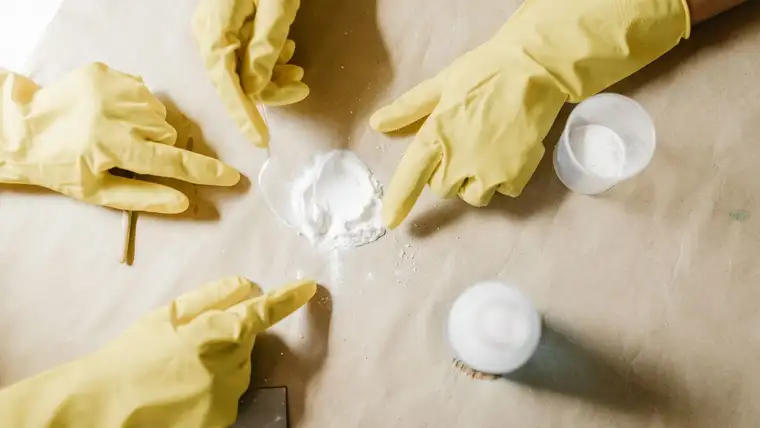
Step by step
- 1
Put on gloves and avoid the dust
Wear waterproof gloves and pour gently so you don't raise a cloud of powder. Keep it away from your eyes.
Why: Borax is corrosive to the eyes and irritating to skin, and University of Georgia Extension advises waterproof gloves with alkalis like borax.
- 2
Check what you're washing
Leave borax out of loads with wool or silk, and don't use it on aluminum surfaces.
Why: Alkalis harm protein fibers such as wool and silk, and they attack aluminum.
- 3
As a booster, follow the box
Add the amount printed on the borax box to the wash along with your usual detergent.
Why: Borax softens the water by tying up hardness minerals, which would otherwise react with the detergent.
- 4
For homemade detergent, mix the extension recipe
UF/IFAS Extension's powder recipe combines 1 cup borax, 1 cup washing soda and 1 grated bar of laundry soap. Mix them in a dry container.
Why: Soap does the cleaning, and the two alkaline powders soften the water and raise the pH so the soap works better.
- 5
Use 2 tablespoons per load
Add 2 tablespoons of the homemade powder to each load.
Why: That's the amount the extension recipe calls for.
- 6
Store it sealed and labeled
Keep borax and any homemade mix in a closed, clearly labeled container, out of reach of children and pets, and never in a food container.
Why: Swallowed borax causes poisoning symptoms, and infants and pets are especially at risk.
What borax is and how it cleans
Borax is a sodium borate salt, sold in US stores as a white laundry booster powder. Borates are also registered pesticide ingredients, which is a reminder that this is an active chemical, not just a mineral.
It works in three ways. It's alkaline, so it raises the pH of wash water, which helps loosen soil. It softens water by tying up the hardness minerals that otherwise react with soap and detergent. And it's a mild cleanser in its own right. University of Georgia Extension also notes that it retards mildew spores and bacteria. On the extension scale of household alkalis it sits above baking soda but well below washing soda and lye.
What borax is good for, with the ratios
- Laundry in hard water: as a booster with your regular detergent, following the box.
- Homemade powder detergent (UF/IFAS Extension): 1 cup borax, 1 cup washing soda and 1 grated bar of laundry soap; use 2 tablespoons per load.
- Nail polish or lacquer on painted walls and plaster (University of Georgia Extension): wipe with 1 tablespoon of borax in 1 pint of warm water. See nail polish stains.
- Iron and rust marks on some hard surfaces: University of Georgia Extension suggests a paste of borax and lemon juice. See rust stains.
What borax damages, and why it isn't 'non-toxic'
- Aluminum: University of Georgia Extension says not to use alkalis on aluminum surfaces.
- Wool and silk: alkalis harm these protein fibers. Follow the care label.
Borax's reputation as a gentle natural cleaner doesn't match the data. The National Pesticide Information Center describes borax as corrosive to the eyes and irritating to skin. Swallowing borates can cause nausea, vomiting, stomach pain and blue-green diarrhea, infants are more sensitive than adults, and pets show similar signs, usually within 2 hours. The EU's harmonized classification, shown in PubChem, lists borax as a reproductive toxicant (Category 1B): it may damage fertility or the unborn child.
No source here documents a specific gas from borax and chlorine bleach, but the general rule still holds: mix bleach only with water. See which cleaning chemicals never to mix.
By situation
Hard water that leaves laundry dingy
This is the job borax suits best. Add it with your detergent as the box directs, so the hardness minerals are tied up before they can react with the detergent.
Wool, silk and delicates
Leave borax out. Use a detergent made for those fibers and follow the care label.
Lacquer or nail polish on a painted wall
Wipe with 1 tablespoon of borax dissolved in 1 pint of warm water, then wipe with plain water. Test on a hidden part of the wall first, since paint finishes vary.
A home with babies, toddlers or pets
Store borax high up in a closed, labeled container and wipe up spilled powder right away. If a child or pet swallows some, call Poison Help at 1-800-222-1222 or your veterinarian.
What not to do
- Don't treat borax as non-toxic. It irritates eyes and skin, causes poisoning symptoms if swallowed, and is EU-classified as a reproductive toxicant.
- Don't store it in a food container or within reach of children and pets. Infants are more sensitive to borates, and pets can be poisoned by eating it.
- Don't use it on aluminum. Alkalis attack and discolor aluminum surfaces.
- Don't add it to wool or silk loads. Alkalis damage protein fibers.
Other methods that work
Washing soda
For heavy grease or very hard water, washing soda is a stronger alkali that also softens water.
Caution: It's harsher on skin and fabric than borax. Wear gloves.
Baking soda
For deodorizing and gentle scrubbing, baking soda is the mildest household alkali.
Caution: It's a weak water softener, so it won't do much for hard-water laundry.
Stain still there?
A stain is still there after a borax wash
Borax helps detergent work in hard water, but it isn't a targeted stain remover. Treat the stain by type first (enzymes for protein, a solvent for oil, oxygen bleach for color), then wash again.
Your hands are dry or irritated after using it
Borax irritates skin. Rinse your hands with water and wear waterproof gloves next time.
Powder got in someone's eyes
Rinse the eyes with plenty of running water and call Poison Help at 1-800-222-1222. Borax is corrosive to the eyes.
Safety
- Wear waterproof gloves and avoid breathing or spreading the dust.
- Store borax closed, labeled and out of reach of children and pets, never in food containers.
- If it is swallowed or gets in the eyes, call Poison Help at 1-800-222-1222.
Never mix cleaning products; see chemicals you must never combine.
Questions
Is borax safe to use for cleaning?
It's usable with care, but not harmless. It irritates eyes and skin, is poisonous if swallowed, and is EU-classified as a reproductive toxicant. Wear gloves and store it away from children, pets and food.
What does borax do in laundry?
It raises the pH of the wash water and softens it by tying up hardness minerals. That helps detergent clean better, especially in hard water.
Is borax the same as boric acid?
No, but they're closely related. Borax is a sodium salt and boric acid is the acid form, and both break down to the same boron compounds. The National Pesticide Information Center covers them together.
Can you mix borax and bleach?
No specific toxic gas from that pair is documented in the sources here, but the safe rule is to mix chlorine bleach only with water and never combine cleaning products.
Does borax kill mold?
University of Georgia Extension says borax retards mildew spores and bacteria. That means it slows their growth; it is not described as a disinfectant.
Other cleaning agents
- Cleaning with acetone: what it removes and what it ruins
- Cleaning with ammonia: what it cleans and what it ruins
- Cleaning with baking soda: what it cleans and what it doesn't
- Cleaning with chlorine bleach: what it cleans and what it ruins
- Cornstarch and other absorbents: how they lift grease stains
- Cleaning with dish soap: what it removes and how much to use
- Dry-cleaning solvent: what it removes and how to use it safely
- Enzyme cleaners: what they break down and how to use them
- Glycerin for stain removal: what it loosens and how to use it
- Hydrogen peroxide for stains: what it removes and what it can lighten
- How to pretreat stains: sprays, gels, sticks and detergent
- Cleaning with lemon juice and citric acid: what it removes and ruins
Sources
- Care Products, University of Georgia Cooperative Extension (Textiles)
- Boric Acid General Fact Sheet, National Pesticide Information Center (Oregon State University / U.S. EPA cooperative agreement)
- Homemade Household Cleaners, FCS3319 (rev. Feb 2025), UF/IFAS Extension
- Remove Stains From Fingernail Polish, Lacquer, University of Georgia Cooperative Extension
- Remove Stains From Iron, Rust, University of Georgia Cooperative Extension
- Borax (CID 16211214): GHS Classification, PubChem, U.S. National Library of Medicine
Last updated . Methods are drawn from the sources above; how we research and check our guides.