Cleaning with vinegar: what it cleans and what it ruins
Cleaning with vinegar works because white vinegar is a dilute acid, about 5% acetic acid. It dissolves alkaline mineral deposits like hard-water scale and soap film, and it neutralizes alkaline residues such as leftover detergent. It isn't a soap, so it does little against grease on its own, it etches marble and limestone, and it must never be mixed with chlorine bleach or hydrogen peroxide.
- Best method
- Dissolving hard-water film and rinsing out detergent residue
- Time
- Short contact, then a rinse or wipe
- Difficulty
- Easy
You will need
- White distilled vinegar
- Water
- A spray bottle
- A few drops of liquid dish soap, for greasy film
- A microfiber cloth or sponge
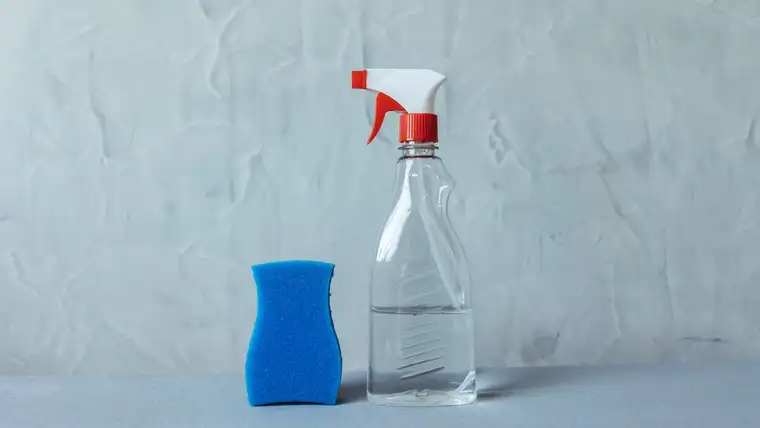
Step by step
- 1
Make sure the surface can take acid
Don't use vinegar on marble, limestone, travertine or onyx, or on grout that's sensitive to acid. On dyed fabric, test a hidden spot first.
Why: Acid dissolves calcium carbonate, so it dulls and etches calcium-based stone whether it's sealed or not.
- 2
Mix an all-purpose spray
Combine 3 tablespoons of white vinegar, 2 cups of hot water and 1 teaspoon of liquid dish soap in a spray bottle, the Vermont Department of Health recipe. For glass, use 2 tablespoons of vinegar, 2 cups of water and 2 drops of liquid soap.
Why: Vinegar handles minerals, but it isn't a surfactant. The soap lifts the oily film that vinegar alone leaves behind.
- 3
Spray and give it a moment on mineral film
Spray fixtures, glass or tile with a hard-water haze and let the solution sit briefly before wiping.
Why: The acid needs a little contact time to dissolve calcium and magnesium deposits.
- 4
Wipe or scrub
Wipe with a microfiber cloth or sponge, working over the haze until it's gone.
Why: Gentle wiping removes the loosened deposits without scratching.
- 5
Rinse with clean water
Rinse or wipe the surface with plain water and dry it.
Why: Rinsing removes the dissolved minerals and any acid left on the surface.
- 6
Keep it away from bleach
Don't use vinegar in a toilet, drain or dishwasher that may still contain chlorine bleach. Flush or rinse thoroughly first, and ventilate the room.
Why: Acid plus bleach releases chlorine gas.
How vinegar cleans: the chemistry
White distilled vinegar is a dilute solution of acetic acid in water, about 5% in grocery-store bottles. Products sold as "cleaning vinegar" are somewhat stronger, often around 6% or more; there's no standard strength, so check the label.
As an acid, vinegar does three useful things. It dissolves alkaline mineral deposits, such as hard-water scale and soap film, which are mostly calcium and magnesium carbonates. It neutralizes alkaline residues, like detergent left in carpet or an ammonia spill. And it can restore some dyes that an alkali has shifted.
What it can't do is cut grease. Vinegar isn't a surfactant, so on oily soil it does little by itself, which is why most recipes add a little soap.
What vinegar is good for, and what it damages
Good for:
- Hard-water stains, soap film on fixtures, and glass. Acid dissolves the mineral deposits.
- Rinsing detergent residue out of carpet. The Carpet and Rug Institute's vinegar solution is a step in its methods for coffee, tea, wine, cola, urine, vomit, mustard, rust, glue and other spots. It lowers the alkalinity that detergent solutions and alkaline spills leave behind.
- Neutralizing alkaline spots and restoring dyes changed by ammonia or other alkalis, with a few drops after rinsing.
Damages:
- Marble, limestone, travertine and onyx, and some grout. The Natural Stone Institute warns that acid dulls or etches calcium-based stone, sealed or not. See how to clean marble.
- Some fabric dyes. Vinegar is safe for fibers but changes some dyes. If a color shifts, rinse and apply a few drops of ammonia, as Georgia's textile guidance suggests.
- Cotton and linen at full strength. Georgia advises diluting vinegar with 2 parts water, because acids weaken plant fibers.
Vinegar ratios, and what never to mix it with
- Carpet rinse (Carpet and Rug Institute): 1 cup white vinegar to 2 cups water. Pretest, especially on wool carpet.
- All-purpose spray (Vermont Department of Health): 3 tablespoons vinegar, 2 cups hot water, 1 teaspoon liquid soap.
- Glass (Vermont): 2 tablespoons vinegar, 2 cups water, 2 drops liquid soap.
- Laundry rinse (Vermont): 1 to 2 cups in the rinse cycle to soften and deodorize. This is a health-department recipe, not a laboratory-tested claim.
Never mix vinegar with:
- Chlorine bleach. The acid releases chlorine gas, and the New Jersey Department of Health says vinegar and bleach give off harmful vapors including chlorine and chloramine.
- Hydrogen peroxide in the same container. Together they form peracetic acid, which is corrosive to eyes, skin and lungs.
- Baking soda, which isn't dangerous but is self-defeating. The two neutralize each other into carbon dioxide, water and sodium acetate. Never seal the mixture in a bottle, because the gas builds pressure.
The full list is in never mix these cleaners.
By situation
A spot on carpet
After blotting the spot with a detergent solution and rinsing, blot on the 1 cup vinegar to 2 cups water solution, then rinse with plain water and blot dry. On wool carpet, pretest first.
Clothes in the wash
A cup or two in the rinse cycle is a common recipe for softening and deodorizing, but its effect hasn't been laboratory tested. On cotton and linen, keep vinegar diluted, and test dyed items.
Marble, limestone or travertine
Don't use vinegar at all, even diluted. It etches calcium-based stone and leaves dull spots that won't wipe off.
Toilets, drains and dishwashers
If chlorine bleach or a bleach-based cleaner might be present, flush or rinse thoroughly before using vinegar, or skip it.
Cleaning vinegar
Higher-strength cleaning vinegar is more acidic than grocery vinegar. No standard strength exists, so read the label, and remember the published recipes assume ordinary 5% vinegar.
What not to do
- Don't mix vinegar with chlorine bleach. Acid and bleach release chlorine gas and other harmful vapors.
- Don't store vinegar and hydrogen peroxide together in one bottle. The mixture forms peracetic acid, which is corrosive to eyes, skin and lungs.
- Don't use vinegar on marble, limestone, travertine or onyx. Acid dissolves calcium carbonate and etches the surface, sealed or not.
- Don't rely on vinegar to disinfect. EPA doesn't evaluate household ingredients like vinegar as disinfectants and can't verify how well they kill germs.
Other methods that work
Dish soap and water
For greasy grime, a mild soap solution does what vinegar can't: surfactants lift oil. It's also the safe choice for natural stone.
Lemon juice or citric acid
Another mild acid for mineral deposits and rust, with the same chemistry and the same limits.
Caution: It etches marble and limestone too, and must never meet chlorine bleach.
Stain still there?
Vinegar didn't cut the grime
If it's greasy, vinegar can't lift it on its own. Use a few drops of dish soap in the solution, or switch to soap and water.
A dull patch appeared on a stone counter
That's acid etching on calcium-based stone. It's damage to the surface, not a residue, and a stone professional can assess it.
A dyed fabric changed color after vinegar
Rinse it well. Georgia's textile guidance says a few drops of ammonia can return an acid-shifted dye. Rinse again afterward, and never use ammonia with bleach.
Safety
- Avoid getting vinegar in your eyes; rinse with plenty of water if it splashes.
- Never use vinegar where chlorine bleach residue may remain, and ventilate when cleaning small rooms.
Never mix cleaning products; see chemicals you must never combine.
Questions
Does vinegar disinfect?
Not in any verified way. EPA does not evaluate household ingredients like vinegar as disinfectants. For disinfecting, use an EPA-registered product according to its label.
Can you mix vinegar and baking soda for cleaning?
You can, but it's self-defeating. They neutralize each other into carbon dioxide, water and sodium acetate, and the fizz is brief. Never cap the mixture in a bottle.
Is vinegar safe on marble or granite countertops?
Not on marble, limestone or travertine, which acid etches. For any natural stone, a neutral cleaner made for stone is the safer choice.
What happens if you mix vinegar and bleach?
The acid makes the bleach release chlorine gas, which irritates eyes, nose and lungs and can cause serious breathing problems. Leave the area and call Poison Help at 1-800-222-1222 if it happens.
Is vinegar safe to use on clothes?
It's safe for most fibers in diluted form, but it can change some dyes. Dilute it with water on cotton and linen and test colored items first.
Other cleaning agents
- Cleaning with acetone: what it removes and what it ruins
- Cleaning with ammonia: what it cleans and what it ruins
- Cleaning with baking soda: what it cleans and what it doesn't
- Cleaning with borax: what it does and how safe it is
- Cleaning with chlorine bleach: what it cleans and what it ruins
- Cornstarch and other absorbents: how they lift grease stains
- Cleaning with dish soap: what it removes and how much to use
- Dry-cleaning solvent: what it removes and how to use it safely
- Enzyme cleaners: what they break down and how to use them
- Glycerin for stain removal: what it loosens and how to use it
- Hydrogen peroxide for stains: what it removes and what it can lighten
- How to pretreat stains: sprays, gels, sticks and detergent
Sources
- Spot Solver, The Carpet and Rug Institute
- Care Products, University of Georgia Cooperative Extension (Textiles)
- Learn About Cleaning Products for Natural Stone, Natural Stone Institute
- Keeping Your Home Healthy, Safe & Clean: Living Green (June 2017), Vermont Department of Health
- Hazard Alert: Mixing Bleach with Other Cleaning Products Can Be Deadly, New Jersey Department of Health
- Can I use common household substances to kill the novel coronavirus?, U.S. Environmental Protection Agency
Last updated . Methods are drawn from the sources above; how we research and check our guides.